> AI DIDN’T ARRIVE WITH A BANG. IT SEEPED INTO THE WORK.

> CAN YOUR ORGANISATION REORGANISE AROUND WHAT AI MAKES POSSIBLE?

What AI changes.
How organisations adapt.
What comes next for you.

FIRST CONTACT WITH AI  //  1978 Phil is eight years old. A machine answers back. Forty-eight years later, that moment is unfolding across the world of work.  ↓

Join the waitlist to receive the private introduction, narrated by Peter Baker, and occasional news about the book. Email verification is required.

Excerpts, launch news and practical observations from the work already changing.

> FOLLOW PHIL ON LINKEDIN
> VIDEO PREVIEW · 02:54

Three excerpts. One arc.

From what AI makes cheap, to a bank that could not catch demand, to a family roster that lasts eleven minutes.

Written by Phil Gray. Narrated by Peter Baker.

LISTEN TO THE AUDIO-ONLY VERSION
03 EXCERPTS 02:54 YOUTUBE CHANNEL TRANSCRIPT
> PUBLICATION SEQUENCE

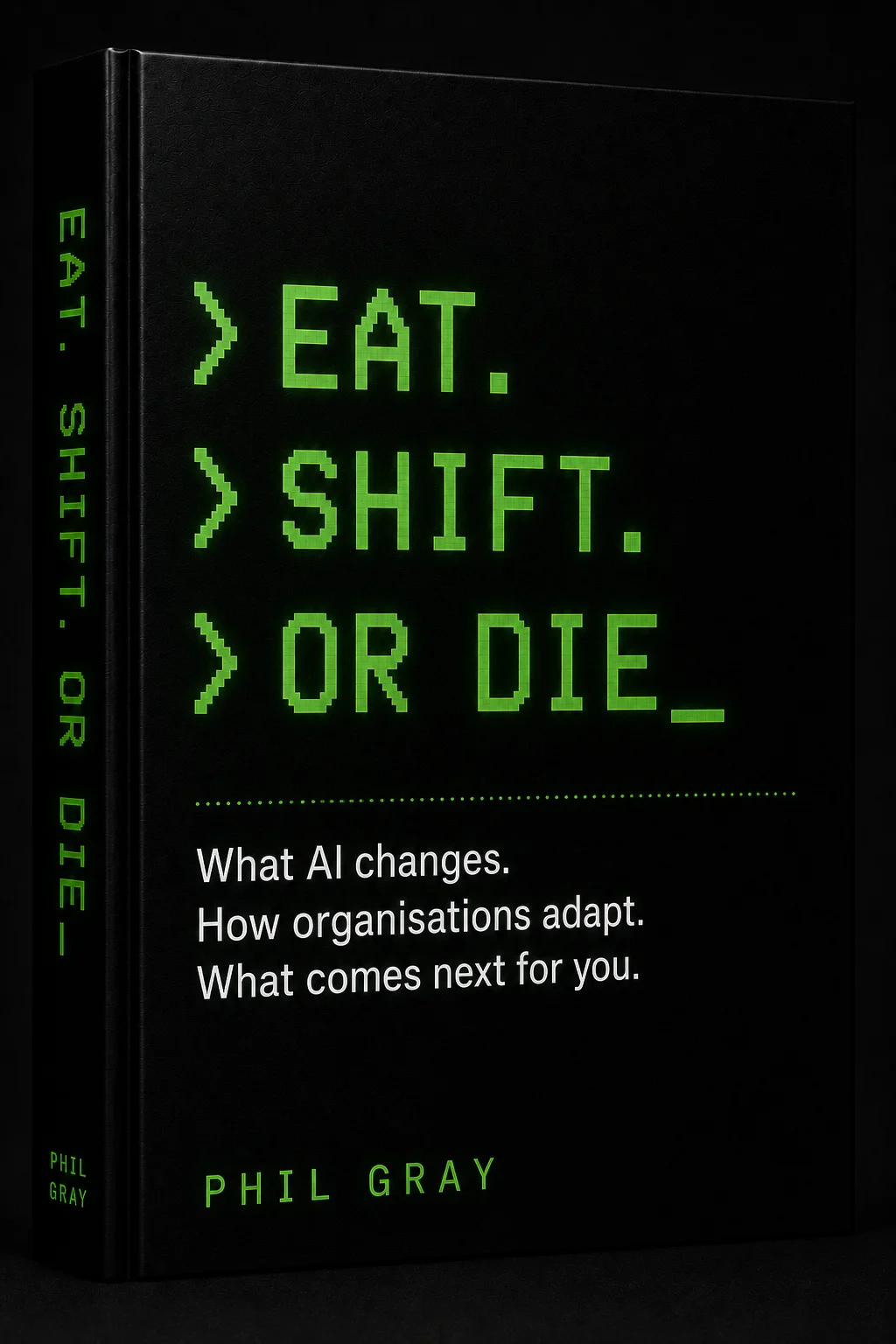
EAT. SHIFT. OR DIE. arrives 25 August 2026.

Publication is on 25 August 2026.

AI is not the story. Your organisation is.

While organisations debate tools, policies and pilots, the deeper shift is already under way.

Expertise is changing. Roles are unravelling. The machinery most organisations use to manage transformation is too slow for what comes next.

EAT. SHIFT. OR DIE. is a practical guide to recognising what AI is changing, reorganising work around what it makes possible, and building organisations able to adapt without waiting for certainty.

It explains what happens to expertise and accountability, why familiar transformation methods fail, and how leaders, managers and professionals can build judgement through practice.

This is not another prediction about the future. It is a field guide for moving before the ground makes the decision for you.

> WHAT CHANGES?
  • ORGANISATIONS.
  • HOW ORGANISATIONS ADAPT.
  • YOU.
> CONTENTS

PART I: WHAT AI CHANGES

AI is not the story. The organisation is. The same technology creates opposite outcomes depending on how work, authority and accountability are designed.

EXECUTE

AI changes the cost of cognitive work, the value of expertise, the speed of decisions and the boundary between producing an answer and remaining accountable for it.
PART II: HOW ORGANISATIONS ADAPT

AI exposes an adaptation deficit: organisations are delegating judgement faster than they can build the context, authority and sense-making needed to govern it.

EXECUTE

Episodic transformation methods are meeting a capability that evolves after implementation, spreads outside formal programmes and forces decisions faster than governance can respond.

PART III: WHAT COMES NEXT FOR YOU

You may not control the clock your organisation is on. You can build the judgement to read it, test what is changing and make the next move more intelligent.

EXECUTE

Small experiments, better signals and direct practice help you develop judgement you can carry into your current role, your own business or whatever comes after either of them.

> RUN THE ADAPTATION STRESS TEST

Five signals. A prompt to look harder, not a verdict.

This illustrative reflection tool is not professional advice or a formal assessment of your organisation.

> RECENTLY DECEASED ASSUMPTIONS

Some management ideas survive long after the conditions that made them useful. AI is shortening the funeral schedule.

  1. FILE 001

    R.I.P. The job description as a fixed object.

  2. FILE 002

    R.I.P. Digital transformation with an end date.

  3. FILE 003

    R.I.P. Training as the answer to every capability problem.

  4. FILE 004

    R.I.P. The organisation chart as a map of how work really happens.

  5. FILE 005

    R.I.P. A transformation plan designed to stop changing.

> THIS BOOK MAY BE FOR YOU IF
  • Your AI strategy is mostly a list of software licences.
  • Your transformation program was designed for a world that no longer exists.
  • You work in change, HR, communications or L&D and suspect the profession itself is about to change.
  • You manage people whose jobs will be redesigned before anyone updates their job descriptions.
  • You run a business that cannot afford an army of strategists, but still has to make consequential decisions about AI.
  • You know something significant is happening, but cannot yet name it.

This is not a book about predicting every technological development. It is about seeing the change clearly enough to make better choices while choices still exist.

Cover of EAT. SHIFT. OR DIE. by Phil Gray.

A field guide for the change already under way

AI is changing expertise, accountability and the shape of work faster than most organisations can redesign themselves.

This field guide explains why familiar transformation methods fail, what AI makes possible, and how leaders, managers and professionals can build judgement through practice.

> FOLLOW PHIL ON LINKEDIN
FIRST CONTACT1978 EXPERIENCE35 YEARS OPERATING MODESCAR TISSUE, NOT THEORY

About Phil Gray

Phil Gray first encountered AI through ELIZA on a TRS-80 in 1978. He has followed its evolution from a compelling experiment to a practical capability reshaping how work gets done.

Across thirty-five years he has built businesses, led enterprise transformation programmes and worked inside organisations optimised for predictability while the world kept moving. He has been the disruptor, the disrupted and the person trying to help incumbents adapt.

EAT. SHIFT. OR DIE. is his first book.

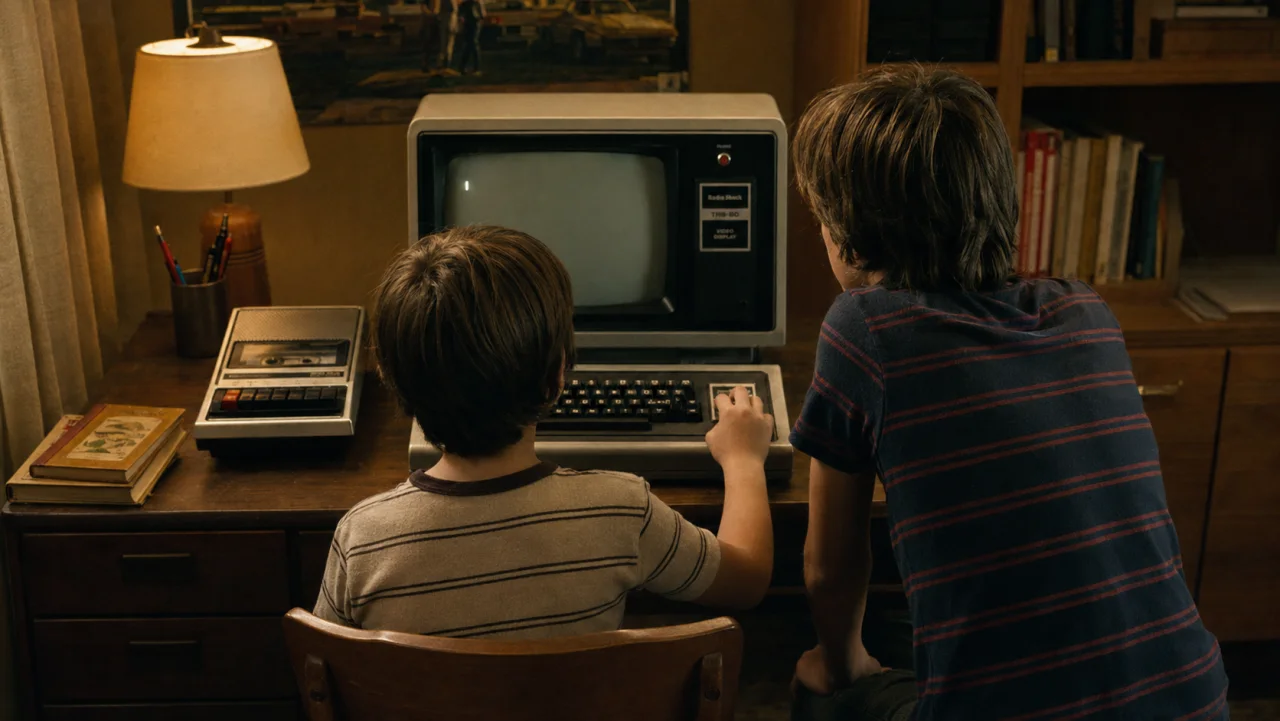
Two boys seen from behind at a desk with a TRS-80 computer in a late-1970s room.

The conversation began in 1978

It was 1978. I was eight years old, in the home office of a senior journalist from Four Corners, staring at silver letters on a futuristic-looking machine: TRS-80.

We loaded a cassette and waited twenty minutes while it screeched and clicked. Then beautiful green text appeared: “HOW DO YOU DO. PLEASE TELL ME YOUR PROBLEM.”

ELIZA did not understand anything. It reflected statements back as questions. None of that mattered. For a moment, the machine seemed to answer back.

Forty-eight years later, the technology has finally caught up with that feeling. Machines can now produce language, analyse information, recommend actions and participate in work.

The demonstration is not the story. What matters is what happens when capability meets work, structure, incentives, identity and people.

> THE FUTURE IS ALREADY AT WORK.

EAT. SHIFT. OR DIE. publishes on 25 August 2026. Join the verified waitlist and Kev247 will send you a private link to the introduction, narrated by Peter Baker.

Publication date: 25 August 2026

No daily AI hot takes. No borrowed certainty. Just the book, the work and what the evidence is starting to say.