What if your AI works,
and the organisation doesn’t?
Explore why faster task completion can leave the actual work stuck at the next decision.
Try the idea ↗The conversation continues
Hear the book. Explore the questions. Find what you need for an interview, review or event.
The book trailer / 02:04
A new analyst gets an answer from AI that took someone else fifteen years to learn. Follow that question back to ELIZA in 1979, then through the shipping container and the changes it demanded.
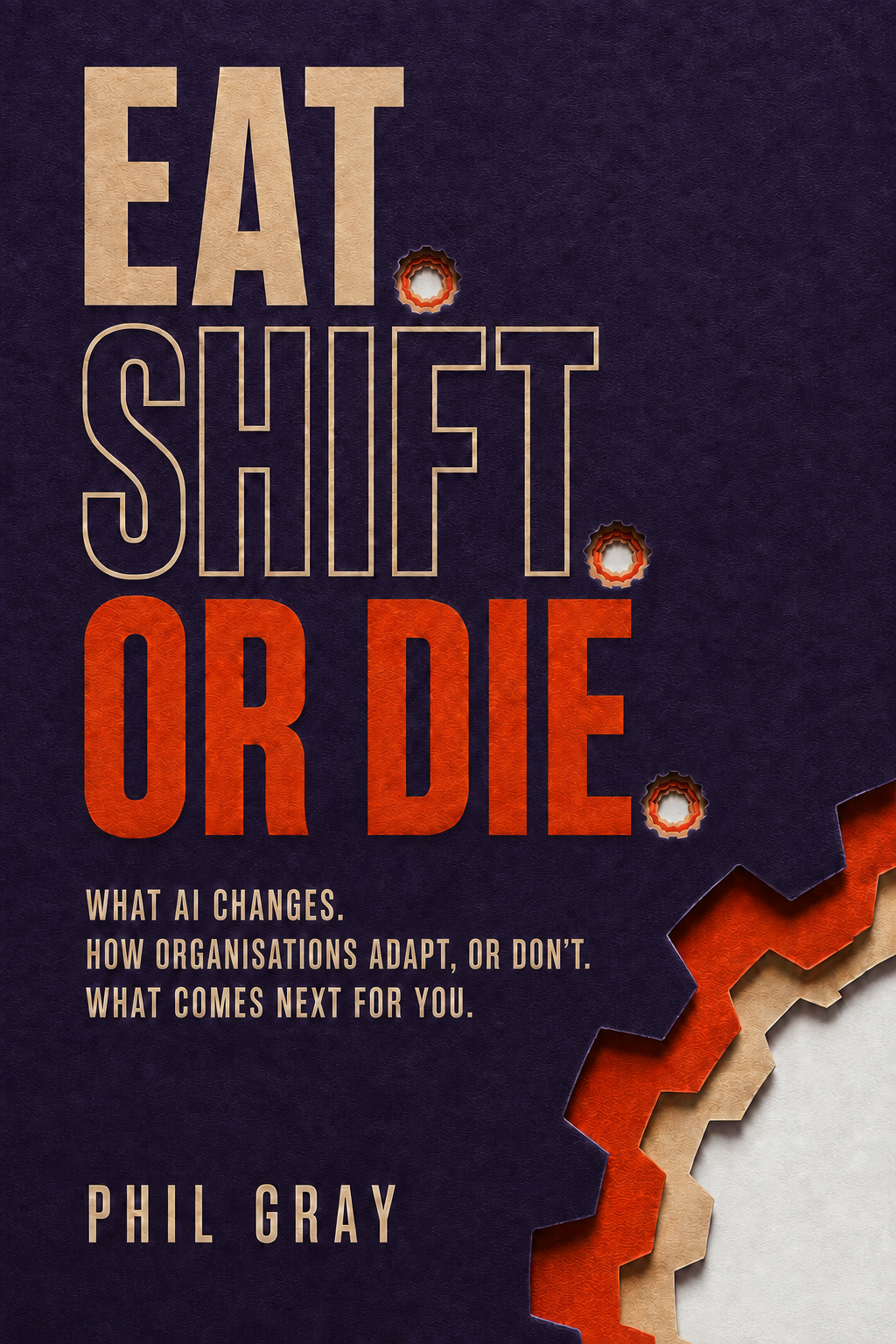
The trailer begins silently on textured aubergine paper. Folded paper reveals each title word in turn: parchment EAT, outlined SHIFT, and orange OR DIE. A young analyst types at a laptop while an older colleague watches the answer arrive. A paper calendar flips backwards from 2026 to 1979, slowing as it approaches a boy at a computer. The boy types and leans towards the screen, followed by ELIZA’s green-screen question. A shipping container lands and paper roads, railway tracks and warehouses unfold around it. Paper office partitions turn as people pass work between desks. An older worker packs his desk, lifts a box and leaves. Layered paper mechanisms move beneath the definitions of Eat, Shift and Or Die. Text cards establish the sequence, distinguish the book from prompt-writing and get-rich advice, and introduce its focus on your organisation, your work and you. The closing card shows the book cover, Phil Gray’s name, 22 September 2026 and eatshiftdie.com. The narration is accompanied by the sound of calendar pages during the backward transition; there is no music.
Start the conversation here
Explore why faster task completion can leave the actual work stuck at the next decision.
Try the idea ↗The book’s production offers a concrete account of authorship, challenge and judgement with several AIs involved.
Read the experiment ↗Small experiments help people build their own understanding of what AI changes in their work.
Make an experiment card ↗For podcasters, journalists and curious people
For media & event organisers
For interviews, speaking, review copies or book enquiries:
info@eatshiftdie.com ↗Publication on 22 September 2026. Cover artwork and notes below may be used when covering the book, with credit to Phil Gray.
Ready for your programme, article or introduction
Phil Gray is the author of Eat. Shift. Or Die. Over thirty-five years he has built businesses, led enterprise transformation and run innovation labs inside global banks. He has been the disruptor and the disrupted. He lives in Sydney with a Tesla, heavy metal and several opinionated machines with names.
Phil Gray is the author of Eat. Shift. Or Die., a book about what AI changes, how organisations adapt, or don’t, and what comes next for you. His interest began with ELIZA on a TRS-80 in a Sydney home office in 1979. Across thirty-five years, he has built businesses, led enterprise transformation and run innovation labs inside global banks across Asia. He has been the disruptor, the disrupted and the person helping others through the collision. He writes about the work around the technology, with experiments, questions and responsibility for what makes it onto the page. He lives in Sydney.
Phil Gray is the author of Eat. Shift. Or Die., a book about what AI changes, how organisations adapt, or don’t, and what comes next for you.
His story begins in a Sydney home office in 1979. A nine-year-old typed into ELIZA on a TRS-80 and a machine answered back. The question that conversation started has followed him through thirty-five years of building businesses, leading enterprise transformation and working in corporate innovation.
He was paid to test computer games after school while his mates did paper runs. He taught Lotus 1-2-3 to sales reps who would rather have been at the pub, watching technology seep into ordinary office work. He built a business that put computer classrooms on wheels and ran training inside a bank.
In innovation labs inside global banks across Asia, he helped build bathroom mirrors that showed people their money and used augmented reality to explore shipping assets the bank had financed. He learned the difference between innovation and innovation theatre by staging a fair amount of both.
He has asked the same question as the disruptor arriving with the demonstration, the leader whose expertise was disrupted and the consultant helping organisations respond. What happens when new capability meets the way an organisation actually works?
He wrote this book with the technology it describes, using several AI systems to research, edit and challenge while retaining responsibility. The companion website shares experiments, exercises and sources. Phil lives in Sydney with a Tesla, heavy metal and machines with names.
For an author photograph, review copy or print-resolution press file, contact Phil.