The next AI supply chain might run through a secondhand bookshop
Editorial illustration
The big story, seen from the shop floor · Technology arriving from outside your industry The Business Standard · 16 August 2026 · Read the report ↗
The AI industry's appetite for material has acquired a wonderfully physical setting: shelves of old books. Reporting drawn from the BBC describes unusual bulk orders, including one that matched a bookseller's normal weekly volume. Sellers welcome the business while wondering where their stock is going. The connection between particular mystery orders and AI companies remains unconfirmed.
The book connection: A technological shift can reach your business as a peculiar customer order. The bookseller doesn't need an AI strategy to find themselves making decisions about it. Watch for the moment an ordinary product becomes valuable for an entirely different reason.
AI has become something you uninstall from Windows
Seepage · Ordinary software maintenance Microsoft Support · 27 August 2026 · Read the release notes ↗
Among the fixes and refinements in this Windows 11 preview update is permission to remove an installed image-generation AI component from supported Copilot+ PCs. Another line makes Fluid Dictation off by default for new users. AI is now sufficiently ordinary to have component-removal instructions and revised defaults beside touchpad settings.
The book connection: Seepage has a second act: deciding which bits to keep. The interesting question becomes whether a particular feature helps with something you actually do. These are changes for specified Windows versions and supported hardware, with staged availability.
You went to Search. It offered to make the study materials
Seepage · A familiar tool takes on more of the task Google, The Keyword · 19 August 2026 · Read the announcement ↗
Google announced practice quizzes in Search, interactive explanations, and file creation in AI Mode. Its example starts with handwritten notes and lecture slides and ends with a study document. The same familiar starting point can now find material, explain it and assemble something from it.
The book connection: The boundary of the job moves inside a product people already use. A search box can become part tutor, part production assistant before anyone gives the change a name. Google describes a mixture of launched and rolling-out features; its announcement doesn't establish that they improve learning.
The university's software update now includes a catch-up colleague
Seepage · AI arrives in the tools around the work UNC Charlotte, Office of OneIT · 7 August 2026 · Read the campus notice ↗
A back-to-semester Zoom notice explains lecture recaps in Canvas, meeting summaries and an AI catch-up prompt for late arrivals. It also covers scheduling and the refreshed web portal. That unremarkable packaging is what makes it interesting: an institution is introducing capabilities through the ordinary business of helping staff use their software.
The book connection: The person taking notes, the person arriving late and the person teaching now have different choices. Start there when asking what has changed. The notice also lists local restrictions, so this is a specific campus example, not a claim that every Zoom feature is enabled everywhere.
Faster coding made this apprenticeship spend longer on the foundations
Editorial illustration
Expertise and apprenticeships · The work after the demonstration AI-First Nation, Laurence Liew · 26 August 2026 · Read the account ↗
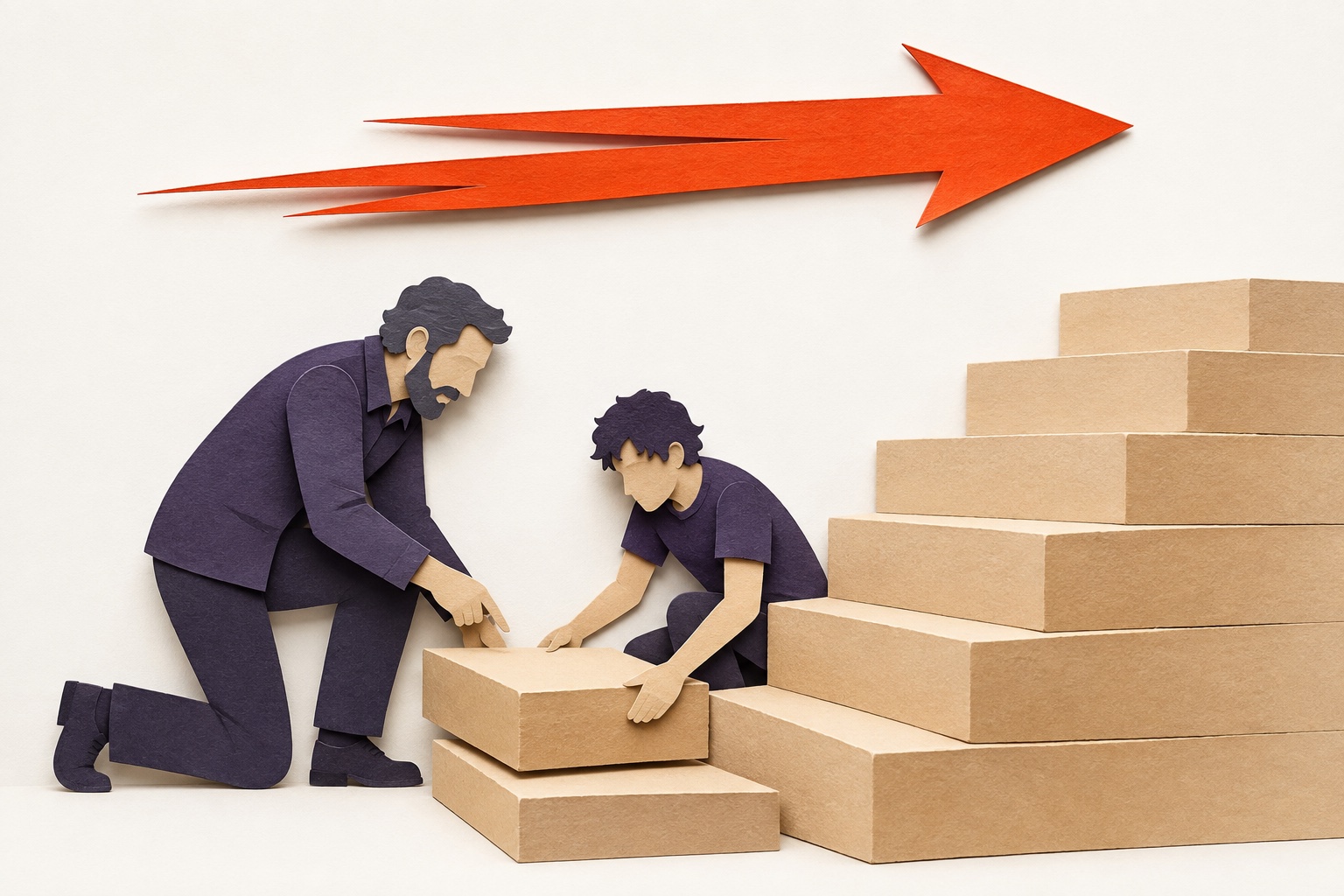
Laurence Liew describes a change to AI Singapore's nine-month apprenticeship: foundation work grew from two months to three, while project work shrank from seven to six. His explanation is that there is more engineering to learn, while generative AI helps prepared teams deliver faster. Apprentices work with mentors on real industry problems through deployment.
The book connection: This is a useful response to the anxiety about losing the first rungs of a career. Redesign the learning, including what beginners must understand before speed becomes useful. The programme's current structure ↗ corroborates the phases; the explanation for the change is Liew's account.
Australia's AI question has reached the way the business runs
Australia · Organisations adapting ABC News, Clare Armstrong · first posted 31 August 2026; updated 1 September · Read the report ↗
Advice to the Treasurer, reported by the ABC, describes Australian AI adoption as widespread but shallow, with fewer than one in ten businesses reporting significant adoption. The proposed next step involves processes, management practices, business models and skills. That is a fairly substantial agenda hiding behind the little word “adoption”.
The book connection: Buying access gets you to the beginning of the organisational work. This is the conversation about who can change a process, who owns the handover and how people learn new ways of working, arriving in a national economic story. The figures and advice here are attributed to the ABC's reporting.
The designer's next job may be choosing what deserves to survive
Work changing shape · Judgement, taste and slop UX Magazine, Rich Weborg · 5 August 2026 · Read the essay ↗
Weborg describes a design process in which more people can produce credible screens early: product managers, engineers and founders can bring something visible to the conversation. He argues that the designer's contribution shifts towards direction, coherence and evaluation. His concern is the spread of polished sameness.
The book connection: Imagine arriving at a meeting with twenty plausible versions instead of one unfinished sketch. You have gained options and acquired a selection problem. Taste starts to look like work you can name, discuss and practise. This is a practitioner's argument, not a measured finding about every design team.
Executive quote · Organisational expectations Thomson Reuters, CIO Jason Escaravage · 5 August 2026 · Read his account ↗
“We expect ALL employees at Thomson Reuters to be using AI, every day.”
Escaravage places that expectation in an account of internal experimentation giving way to habits, manager coaching and changes to whole workflows. It is a strikingly direct statement of what an employer now expects of professional practice.
The book connection: Once using the tool is expected, the useful conversation concerns what people use it for, what they learn and what counts as a good result. A daily-use expectation creates those questions; it doesn't answer them. This is the company's stated approach, with its outcomes still to be judged.
August's anniversary marks the web's public announcement in 1991. CERN's history ↗ supplies the less glamorous detail: the first browser needed a NeXT computer. Nicola Pellow's simpler browser could run on other systems. Later, friendly browsers for common computers helped the web spread.
The book connection: Keep an eye on the people making a capability usable in ordinary circumstances. The spectacular invention needs that work around it. This anniversary concerns public introduction: the proposal dates to 1989 and the first server and browser were running in 1990.
Your next garden gadget would like to establish air superiority
The weird weak signal · Capabilities finding unexpected uses Tom's Hardware, Jowi Morales · 15 August 2026 · Read the story ↗
Photon Matrix pitches a device that detects flying insects and targets them with a laser. The combination includes sensing hardware and an AI vision module. The August story reported the manufacturer's production plans; the current shop page ↗ still calls it a pre-order. Confirmed delivery and independent performance are separate questions.
The book connection: Once capabilities become available as components, people put them together around remarkably specific irritations. Apparently that includes mosquitoes. Worth watching for the unexpected application, and for the journey from an impressive demonstration to something people actually live with.